

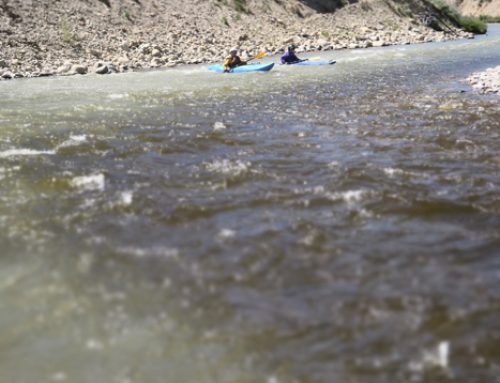
The water was milk chocolate brown, with a slippery texture that required an extra tight grip on the paddle. Close your eyes when splashed or you’d feel the grit in your eyeballs. Flipping over was a very bad idea. Sunscreen wasn’t necessary. The mud film that collected on my exposed shoulders formed a thorough coat of UV protection.

Moenkopi Wash is a tributary of the Little Colorado River, and on this day, tributary flexed over main-stem. The gage said a peak of 7,000 cfs was roaring down Moenkopi. But dry washes that suddenly fill with flood mud are difficult to measure; water mysteriously vanishes into sand, spills over into closed basins, percolates into tamarisk swamps. My partner Jesse Perry and I felt the flow at our location was closer to 2,000. Measurements from our friends at USGS confirmed our lower estimate. It was actually just under 2,000.

A cow nervously ran along the bank. Bushes and trees rode the flood; cottonwood and juniper and tamarisk emerging like hippos from the dark. We might have surfed the sand waves, or the ledge holes, but the lurking debris deterred us.

Our mocha Moenkopi reached the warm maroon of the Little C. The sediment-filled flows continued toward Grand Canyon, where they might build beaches, or further fill Reservoir Mead. We, in turn, walked to the canyon rim in semi-humid heat of the Arizona monsoon, and watched billowing white clouds on the horizon. One of those storms, we hoped, might stray our way and wash the earth from our limbs, back to the river until the next flood, ever onward.



Leave A Comment